
How to Choose an Orthopaedic Sleep Tool — A Clinical Buyer's Guide
The market calls everything "orthopaedic." Memory foam. Buckwheat. Contoured latex. Magnetic inserts. Almost none of it meets any clinical standard. Here is the framework that separates genuine structural correction from expensive comfort with a label upgrade.
October 16, 2026
·
Ilona Navickienė, Founder
·
Reading time:
~
1
min.

The market calls almost everything orthopaedic: memory foam, buckwheat, contoured latex, water-filled pillows. On a pillow, the word usually describes a shape, not a tested function. This guide is for people who want to understand the difference before they spend money.
It starts with a point most sleep marketing avoids: comfort and support are different goals. Then come five questions to ask of any product, an honest comparison of materials, and what the registrations and guarantees printed on the box really mean — including those of our own Neck Pain & Sleep Reset Kit™.
Comfort and Support Are Different Goals
The word pillow promises softness: something that adapts to you. That is exactly what you want from comfort — and the opposite of what support needs. A support holds a height and a shape under the weight of your head. A soft surface yields to whatever position your head already takes.
This has a practical consequence. A product sold as a pillow is expected to feel good on night one. A firm support often feels strange at first and needs an adaptation period, which is why so many people give up on it in the first week.
A comfort-first pillow
Designed to feel good straight away. Shapes itself around your head's existing position and needs no adaptation. Softens and changes shape with use, so it is replaced every few years.
A firm support
Designed to hold a height and shape. Keeps its form under the weight of the head and usually needs a few weeks of adaptation. Holds its shape for years.
Neither is wrong. If your nights are fine, a comfortable pillow may be all you need. If you wake stiff, the question worth asking is not how soft your pillow feels, but what position it leaves your neck in for seven or eight hours.
Five Questions to Ask Any Sleep Support
Strip away the labels — ergonomic, contoured, pressure-relieving, clinically inspired — and any sleep support can be judged on five practical questions.
- Question 1
Does it hold its height through the night?
Soft fillings compress under the weight of your head, so the height you feel when you lie down is not always the height you sleep at. A support that doesn't compress keeps the same position from the first hour to the last.
- Question 2
Can the height be set to you?
Research shows support height changes how hard the neck muscles work and how the cervical spine is aligned during sleep — especially on your side. [1][2][3] Shoulder width and sleep position change the height you need, so one fixed height can't suit everyone.
- Question 3
Will it keep its shape for years?
Foam and loose fillings soften and shift with use, and a support that changes shape changes the position it gives you. Ask how long the product is expected to last, and whether the warranty backs that up.
- Question 4
Is it comfortable enough to keep using?
Firmness takes getting used to, but comfort still matters: a support you abandon does nothing. Consider the materials against your skin, how warm you sleep, and whether the cover can be washed.
- Question 5
Is the evidence honest about its limits?
Research supports the principle that height and shape affect neck position during sleep. It does not prove that any particular product — ours included — reduces neck pain, and an independent review found no effect on subjective sleep quality. [2] Be wary of percentages without a source, studies you can't find, and the words “clinically proven” on a pillow.
Foam, Latex, Buckwheat, Water, Wood: An Honest Comparison
Every material has real strengths. The table compares general material properties against the questions above. These are not tests of particular products, and individual products vary.
How the main materials compare
General properties, not product test results
| Material | Holds height overnight | Adjustable height | Keeps shape over years | Feel |
|---|---|---|---|---|
| Standard foam | Compresses under the head | Usually not | Softens with use | Soft; can feel warm |
| Memory foam | Moulds to your current position | Some models, with inserts | Softens with use | Soft and slow to respond; can feel warm |
| Latex | Springier than foam, still yields | Some models | Lasts longer than foam | Resilient and breathable |
| Buckwheat | Holds better, but the hulls shift | Yes, by adding or removing hulls | Hulls break down over time | Firm and breathable; can rustle |
| Water-filled | Yields to the head | Yes, by fill level | Depends on construction | Soft; can move under you |
| Solid wood (the Kit™) | Does not compress | Yes, with a height insert | Does not soften; lifetime warranty | Firm; needs an adaptation period |
No material in this table, wood included, has been shown in its own trial to reduce neck pain.
Wood isn't the answer for everyone. It is firm, it takes weeks to get used to, and it asks for a commitment a soft pillow doesn't. What it offers is a fixed, adjustable height that stays the same night after night — the variable the research points to.
What Registrations and Labels Really Tell You
Words like orthopaedic, ergonomic and clinically designed on a box are not evidence of anything by themselves. Two kinds of registration are easy to confuse, and both come up in this category.
Design and trade mark registration
Recorded with the EU Intellectual Property Office (EUIPO). A registered design protects how a product looks from being copied; a trade mark protects a name. Neither assesses whether a product works or is safe.
Medical device conformity (CE marking)
Applies to products placed on the market as medical devices under EU Regulation 2017/745, and involves a conformity assessment and technical documentation. A design or trade mark registration is not this.
Ours, stated plainly
The Kit™'s shape is a registered Community design, No. 009206642-0001, with Ilona Navickienė named as its designer.
UNUSUALLY USUAL® is an EU trade mark, No 018775641, registered in Class 10 (medical pillows; orthopaedic products) and Class 20 (pillows). A trade mark registration protects a name. It is not a medical device approval, a safety certification, or an assessment of the product, and Class 10 here is a trade mark goods classification — it has nothing to do with device classes under EU Regulation 2017/745.
We don't claim a CE mark or any device approval. Our design and trade mark page sets out both registrations in full.
When a product claims a registration, ask what it covers: a design, a name, or a medical device assessment. An honest seller can answer in one sentence.
How to Read a Guarantee
A thirty-day return window tells you a product should feel comfortable within thirty days. That is a fair test of comfort. It is a short test of whether your mornings change, because research reads that kind of outcome at about three months.
90 Nights, because that is when the research reads its outcome. The largest sleep-surface trials take their measurements at three months, so we give you the whole window, not a shorter one that would close before the reading is taken. [4]
The adaptation guarantee
90 Nights. Thirty of them on it. Return shipping covered.
This is not a satisfaction guarantee. It is an adaptation guarantee.
Read the full guaranteeRead the conditions as well as the length. A guarantee that asks you to try the product properly, and refunds you if it hasn't worked, is a different promise from one that only covers an unused product.
The Kit™: What It Is — and What It Isn't
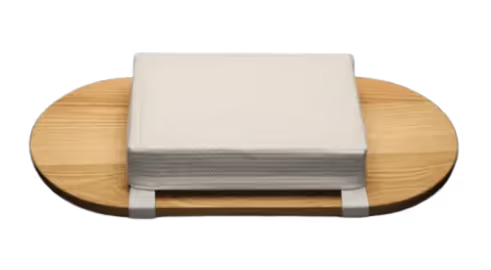
The Neck Pain & Sleep Reset Kit™ by Unusually Usual is a corrective alignment tool: a hand-finished Lithuanian ash sleep support with an adjustable-height insert, designed by Ilona Navickienė. It has not been tested in its own clinical trial, and we claim no CE mark or medical-device approval. It applies the principle research supports — that the height and shape of what supports your head affect neck alignment and muscle load during sleep. The evidence, and its limits, are on our clinical claims page.
What's in the Kit™
- The wooden sleep tool, with your chosen cover fitted
- The Wooden ARCH™, for 10–15 minutes of daytime self-massage and rolling
- A printed user guide
- The Digital Sleep Wellness Masterclass and Bad Posture Reset Program
- 90 days of personal email support
- Lifetime warranty and free worldwide shipping
What it costs
From €395 with a cotton cover, €405 with linen and €425 with silk. Over ten years, €395 works out at about €0.11 a night.
For comparison: a €50 pillow replaced every two years costs about €250 over the same decade.
What consistent Kit™ users report
89%Significantly less morning neck stiffness
68%Fewer morning headaches
79%Improved overall wellness
Self-reported by consistent Kit™ users, beginning at the four-week adaptation period. Not a clinical trial. Details on our clinical claims page.
“I'm not going back to that normal, regular soft pillow anymore.”
So which sleep tool is best for neck pain? Honestly: the one that holds a height set to your body, keeps its shape, is comfortable enough to keep using, and comes from a seller who tells you what the evidence does and doesn't show. We built the Kit™ to meet the first three. This page is our attempt at the fourth.
“Structure first. Awareness second. Consistency and sustainability always. Sleep naturally follows.”
Key facts
From €395about €0.11 a night over ten years
Lifetimewarranty on the sleep tool
30 nightsall we ask before you decide
90 nightswhen the research reads its outcome [4]
EU-protected original · Registered design No. 009206642-0001
Not a comfort product. A corrective alignment tool — try it for 90 nights. All we ask is thirty of them.
Research-based design. Lifetime warranty. Natural Lithuanian ash, hand-finished in Lithuania. The evidence — and what it doesn't show — is there for you before you decide.
Explore the Kit™View clinical evidenceNot a satisfaction guarantee — an adaptation guarantee. 90 Nights. Thirty of them on it. Return shipping covered.
People also ask
Common questions about choosing a sleep tool
Short answers to the questions people ask most when comparing sleep supports.
What makes a sleep tool orthopaedic, rather than just labelled that way?
On pillows, “orthopaedic” usually describes a shape, not a tested function, and the word alone isn't evidence of anything. The useful questions are practical: does it hold its height through the night, can the height be set to your body and sleep position, does it keep its shape for years — and does the seller tell you honestly what the evidence does and doesn't show.
→ Full answer: Five questions to ask any sleep support
Can I use a firm sleep support alongside physiotherapy?
Yes, and it's worth telling your physiotherapist. Treatment and exercise work on how your neck moves while you're awake; a sleep support only changes the position your neck rests in at night. They work alongside each other, not instead of each other — and if your physiotherapist's advice differs from ours, follow theirs.
→ Read more: What each approach does — and doesn't
Is a wooden sleep tool suitable if I have arthritis in my neck?
Ask your doctor or physiotherapist first, especially during a flare-up, after recent neck surgery or injury, with severe osteoporosis, or if you have been told your neck is unstable. A firm support isn't the right choice for everyone, and someone who knows your history is the right person to decide.
Why does the Kit™ cost from €395 when many pillows cost €30–80?
Because it's built to be bought once. The sleep tool is hand-finished from solid Lithuanian ash and carries a lifetime warranty, and the Kit™ also includes the Wooden ARCH™, the digital programme and 90 days of personal email support. Over ten years, €395 works out at about €0.11 a night.
→ Full answer: The Kit™: what it is — and what it isn't
What is the difference between a registered design and CE marking?
A registered Community design protects how a product looks from being copied. CE marking applies to products placed on the market as medical devices, under EU Regulation 2017/745. The Kit™ holds a registered design and a trade mark; neither is a safety certification, and we don't claim a CE mark or any device approval.
→ Full answer: What registrations and labels really tell you
Does the cover material change how the Kit™ works?
No. The wooden sleep tool underneath is identical with all three covers. The difference is feel: cotton is the most breathable and the easiest to wash, linen is slightly firmer to the touch and softens with use, and silk is the smoothest. All three are natural, removable and washable. Choose the one you'll be happiest sleeping on — comfort helps you through the adaptation period.
→ Read more: Choose your cover
Medical disclaimer: This article is for informational and educational purposes only and does not constitute medical advice. Mind Your Sleep by Unusually Usual does not diagnose, treat or cure any medical condition. Always consult your qualified healthcare provider before making changes to your health management or sleep routines. Research is cited with its limits; individual experiences vary.
References
- Lei JX, Yang PF, Yang AL, Gong YF, Shang P, Yuan XC. Ergonomic considerations in pillow height determinants and evaluation. Healthcare (Basel). 2021;9(10):1333. https://pmc.ncbi.nlm.nih.gov/articles/PMC8544534/
- Pang JCY, Tsang SMH, Fu ACL. The effects of pillow designs on neck pain, waking symptoms, neck disability, sleep quality and spinal alignment in adults: a systematic review and meta-analysis. Clinical Biomechanics. 2021;85:105353. https://pubmed.ncbi.nlm.nih.gov/33895703/ — The review found no effect on subjective sleep quality.
- Jiao R, et al. The impact of pillow height on neck muscle activity: a pilot study. Sleep and Breathing. 2024. https://pubmed.ncbi.nlm.nih.gov/39625641/
- Kovacs FM, Abraira V, Peña A, et al. Effect of firmness of mattress on chronic non-specific low-back pain: randomised, double-blind, controlled, multicentre trial. The Lancet. 2003;362(9396):1599–1604. https://pubmed.ncbi.nlm.nih.gov/14630439/ — Cited for its ninety-day measurement point only.
Our approach
Neck Pain & Sleep Reset Kit™
Physiotherapist-designed · EU-protected original · 90-Night Adaptation Guarantee · Lifetime Warranty




Investment in your wellness
Your body has been waiting long enough.
The Neck Pain & Sleep Reset Kit™ by Unusually Usual® -
a registered Community design, made for a range of body types and sleep positions.
begin my recovery
90-Night Guarantee · Lifetime Warranty · Ships Worldwide · EU-Registered
Mind Your Sleep
Get Unusually Usual now
mind your Sleep
get UNUSUALLY USUAL now
Want to see howwe help people?
we help
people?
Free resources, from the heart

Workshops
Body Mindfulness Videos
PDFs
Join Unusually Usual ® Followers
& get a free webinar now!
& get a free webinar now!
Thank you! Your submission has been received!
Oops! Something went wrong while submitting the form.