
The Difference Between Neck Pain Relief and Neck Pain Correction
Massage, heat and painkillers ease neck pain — and for many people it comes back. Here is the difference between easing pain and changing what keeps provoking it, by day and at night, and what the evidence says about each.
October 16, 2026
·
Ilona Navickienė, Founder
·
Reading time:
~
1
min.

If your neck pain keeps returning — after massage, after painkillers, after every pillow you've tried — you're not imagining it, and you're not doing anything wrong. Most of what people reach for is designed to make neck pain feel better now. Far less of it changes the conditions that keep provoking the pain in the first place.
This article explains the difference between those two goals, what each common approach can and can't do, and what changing the conditions actually takes — by day, and during the hours you sleep. It also explains where our Neck Pain & Sleep Reset Kit™ fits, and where it doesn't.
Two Different Goals
Relief eases how pain feels right now. It works quickly, and its effect fades.
Correction, as we use the word, changes the daily and nightly conditions that keep provoking the pain: how your neck is loaded while you're awake, and how it's supported while you sleep. It takes weeks, it needs consistency, and its effect lasts only as long as the new conditions do. It doesn't mean changing the structure of your spine, and we don't claim that it does.
Relief
Eases the symptom. Works quickly; the effect fades. Examples: massage, heat and cold, painkillers, TENS.
Correction
Changes the conditions. Takes weeks and needs consistency. Examples: exercise and movement, screen habits, consistent support at the right height at night, professional guidance.
Neither is better in every situation. Relief has real value: it reduces suffering, and it can make the work of changing the conditions possible. The problem comes only when relief is all there is, and the pain is expected to stay away on its own.
Why Neck Pain Keeps Coming Back
For many people, the pattern is familiar: the pain eases, life carries on, and a few days or weeks later it's back. That isn't random. It's what happens when relief is applied to pain whose conditions haven't changed.
-
Stage 1
The load builds
Hours of looking down at screens load the neck well beyond its neutral weight, [1] and a night on a support that leaves the neck bent adds hours more.
-
Stage 2
Tension and pain
The muscles brace against the load. Stiffness and pain follow, often worst in the morning or by the end of a screen-heavy day.
-
Stage 3
Relief
Massage, heat or a painkiller eases it. That relief is real, and welcome.
-
Stage 4
The conditions return
The screen hours and the night-time position haven't changed, so the tension builds again — and so does the pain.
Neck pain isn't only mechanical. Stress, sleep, how active you are and how worried you are about the pain all play a part, which is one reason the same neck can feel very different from week to week.
Why a scan doesn't always explain it
Disc changes are common on scans of people with no neck pain at all. In a study of 1,211 adults without neck symptoms, disc bulging showed up on MRI in most of them, [2] and an earlier study found degenerated or narrowed discs in almost 60% of symptom-free people over forty. [3] What a scan shows and what you feel don't always match — which is why we talk about changing the conditions, not about “fixing” structure.
What Each Approach Does — and Doesn't
Every common approach has genuine value within its own job. The mistake is expecting a relief tool to do a correction job.
Massage
Relief. Eases muscle tension and often feels very good. When the daily load and the night-time position stay the same, the tension tends to return.
Heat and cold
Relief. Heat loosens tight muscles; cold can calm a recent flare. Both are useful and cheap. Neither changes how the neck is loaded or supported.
Painkillers
Relief. Can take the edge off for a while. Follow the label or your pharmacist's advice, and see a doctor if you find you need them regularly.
TENS
Relief. Small electrical pulses that can reduce how strongly pain is felt while the device is on. The effect stops when the stimulation does.
Exercise and movement
Changes the conditions — strongest evidence. Strengthening and mobility exercise, often combined with other care, is what clinical guidelines for neck pain recommend most consistently. [4] It works on the hours you're awake.
Physiotherapy
Changes the conditions — guideline-recommended. Guidelines recommend a combination of exercise, hands-on treatment and education, tailored to the type of neck pain. [4] Results depend on keeping the exercises going.
Support at night
Changes the night-time conditions — evidence still limited. Support height changes how hard the neck muscles work and how the cervical spine is aligned during sleep. [5][6] Research hasn't shown that any pillow reduces chronic neck pain, and one review found no effect on sleep quality. [7]
What Changing the Conditions Takes
None of this is complicated. It asks for consistency more than effort.
-
Step 1
Know when to get checked
See a doctor first if your neck pain followed a fall or injury, comes with numbness, tingling or weakness in the arms, problems with balance or hand coordination, fever or unexplained weight loss, or is severe, worsening, or still there after a few weeks.
-
Step 2
Move and strengthen by day
Short breaks from the screen, strengthening the deep neck muscles and posture awareness change how the neck is loaded while you're awake. The Body Mindfulness courses by Ilona Navickienė offer a structured way to build the habit.
-
Step 3
Support your neck at night
A firm support at a height set to your body and sleep position changes the position your neck rests in for six to eight hours. Because it's the same every night, it's the part that needs the least willpower.
-
Step 4
Give it honest time
Changing conditions takes weeks. On a new sleep support, the first four weeks are adaptation and the next four consolidation; research reads outcomes at around three months. [8]
“The body is not a problem to fix. It is a system to understand.”
What Relief Costs Over Time
Relief has a running cost, because it repeats. It's worth adding up honestly: a €60 massage once a month is €720 a year, before painkillers and replacement pillows. Massage and physiotherapy can be worth every cent — the point is to know what you're paying for, relief or change, and to make sure at least part of the budget goes to change.
The Kit™ costs from €395, once, with a lifetime warranty on the sleep tool. Over ten years that works out at about €0.11 a night.
Where the Kit™ Fits
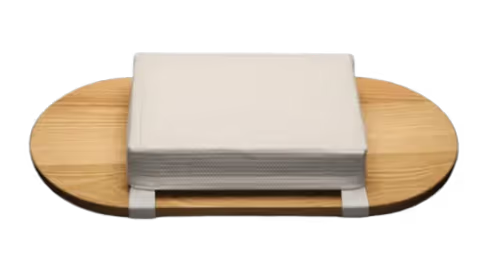
The Neck Pain & Sleep Reset Kit™ by Unusually Usual is a corrective alignment tool for the night-time part of this picture: a hand-finished Lithuanian ash sleep support with an adjustable-height insert, designed by Ilona Navickienė for back and side sleeping. It has not been tested in its own clinical trial, and we claim no CE mark or medical-device approval. The evidence, and its limits, are on our clinical claims page.
The Kit™ also includes the Wooden ARCH™ for 10–15 minutes of daytime self-massage and rolling — relief, in this article's terms, and useful as such — plus the Digital Sleep Wellness Masterclass, the Bad Posture Reset Program and 90 days of personal email support for the daytime habits.
What consistent Kit™ users report
89%Significantly less morning neck stiffness
68%Fewer morning headaches
79%Improved overall wellness
Self-reported by consistent Kit™ users, beginning at the four-week adaptation period. Not a clinical trial. Details on our clinical claims page.
“When I wake up, I feel that I slept well, nothing ever hurts.”
90 Nights, because that is when the research reads its outcome. The largest sleep-surface trials take their measurements at three months, so we give you the whole window, not a shorter one that would close before the reading is taken. [8]
The adaptation guarantee
90 Nights. Thirty of them on it. Return shipping covered.
This is not a satisfaction guarantee. It is an adaptation guarantee.
Read the full guaranteeOne question to ask of anything you try
Am I easing how this feels today — or changing what keeps provoking it? Both have a place. Knowing which one you're doing is what stops the cycle from repeating.
For more, our article What Is Phone Neck Syndrome? explains how screen posture loads the neck, and the Journal also covers the first ninety nights, how to choose a sleep tool and how sleep position affects the neck.
Key facts
EU-protected original · Registered design No. 009206642-0001
Not relief for a night. A corrective alignment tool for every night — try it for 90 nights. All we ask is thirty of them.
Research-based design. Lifetime warranty. Natural Lithuanian ash, hand-finished in Lithuania. The evidence — and what it doesn't show — is there for you before you decide.
Explore the Kit™View clinical evidenceNot a satisfaction guarantee — an adaptation guarantee. 90 Nights. Thirty of them on it. Return shipping covered.
People also ask
Common questions about neck pain relief and correction
Short answers to the questions people ask most when neck pain keeps returning.
How do I know if my neck pain is muscular or something more serious?
You usually can't tell reliably on your own, and most neck pain has no single identifiable cause. See a doctor if the pain followed a fall or injury, comes with numbness, tingling or weakness in the arms, balance problems, fever or unexplained weight loss, or is severe, worsening, or lasts more than a few weeks. Pain that keeps coming back is a good reason to get advice — not a diagnosis in itself.
→ Full answer: What changing the conditions takes
Why does neck pain come back after massage?
Massage eases muscle tension, and that relief is real. But if the hours of screen loading and the night-time position stay the same, the muscles go back to bracing against them, and the tension returns. That's not a failure of massage. It's a sign that the conditions provoking the pain haven't changed.
→ Full answer: Why neck pain keeps coming back
Can physiotherapy fix neck pain for good?
Physiotherapy that combines exercise, hands-on treatment and education is the approach clinical guidelines recommend. [4] Results depend on keeping up the exercises, and neck pain can still return from time to time. A good sleep support works alongside physiotherapy, never instead of it — and if your physiotherapist's advice differs from ours, follow theirs.
→ Full answer: What each approach does — and doesn't
Is chronic neck pain a normal part of ageing?
Disc changes become more common with age — including in people who have no neck pain at all. [2][3] So age-related changes on a scan don't mean pain is inevitable, and they don't always explain pain when it is there. Staying active and looking after how your neck is loaded and supported helps at any age.
→ Full answer: Why a scan doesn't always explain it
How long does it take to change what keeps provoking neck pain?
Weeks rather than days. Exercise programmes usually run over several weeks. On a new sleep support, the first four weeks are adaptation, and research reads outcomes at around three months. [8] There's no fixed timeline that fits everyone.
→ Full answer: What changing the conditions takes
What is the single most effective thing for persistent neck pain?
There usually isn't a single one. Guidelines favour exercise, often combined with hands-on treatment and education. [4] Night-time support adds the six to eight hours you spend asleep, but we don't claim it is the most effective option on its own — the best results tend to come from day and night working together.
→ Full answer: What each approach does — and doesn't
Medical disclaimer: This article is for informational and educational purposes only and does not constitute medical advice. Mind Your Sleep by Unusually Usual does not diagnose, treat or cure any medical condition. Always consult your qualified healthcare provider before making changes to your health management or treatment plan. Research is cited with its limits; individual experiences vary.
References
- Hansraj KK. Assessment of stresses in the cervical spine caused by posture and position of the head. Surgical Technology International. 2014;25:277–279. PMID: 25393825. A computer model; values are estimates.
- Nakashima H, Yukawa Y, Suda K, Yamagata M, Ueta T, Kato F. Abnormal findings on magnetic resonance images of the cervical spines in 1211 asymptomatic subjects. Spine. 2015;40(6):392–398.
- Boden SD, McCowin PR, Davis DO, Dina TS, Mark AS, Wiesel S. Abnormal magnetic-resonance scans of the cervical spine in asymptomatic subjects: a prospective investigation. Journal of Bone and Joint Surgery (American). 1990;72(8):1178–1184. https://pubmed.ncbi.nlm.nih.gov/2398088/
- Blanpied PR, Gross AR, Elliott JM, Devaney LL, Clewley D, Walton DM, Sparks C, Robertson EK. Neck pain: revision 2017. Journal of Orthopaedic & Sports Physical Therapy. 2017;47(7):A1–A83. doi:10.2519/jospt.2017.0302
- Lei JX, Yang PF, Yang AL, Gong YF, Shang P, Yuan XC. Ergonomic considerations in pillow height determinants and evaluation. Healthcare (Basel). 2021;9(10):1333. https://pmc.ncbi.nlm.nih.gov/articles/PMC8544534/
- Jiao R, et al. The impact of pillow height on neck muscle activity: a pilot study. Sleep and Breathing. 2024. https://pubmed.ncbi.nlm.nih.gov/39625641/
- Pang JCY, Tsang SMH, Fu ACL. The effects of pillow designs on neck pain, waking symptoms, neck disability, sleep quality and spinal alignment in adults: a systematic review and meta-analysis. Clinical Biomechanics. 2021;85:105353. https://pubmed.ncbi.nlm.nih.gov/33895703/ — The review found no effect on subjective sleep quality.
- Kovacs FM, Abraira V, Peña A, et al. Effect of firmness of mattress on chronic non-specific low-back pain: randomised, double-blind, controlled, multicentre trial. The Lancet. 2003;362(9396):1599–1604. https://pubmed.ncbi.nlm.nih.gov/14630439/ — Cited for its ninety-day measurement point only.
Our approach
Neck Pain & Sleep Reset Kit™
Physiotherapist-designed · EU-protected original · 90-Night Adaptation Guarantee · Lifetime Warranty




Investment in your wellness
Your body has been waiting long enough.
The Neck Pain & Sleep Reset Kit™ by Unusually Usual® -
a registered Community design, made for a range of body types and sleep positions.
begin my recovery
90-Night Guarantee · Lifetime Warranty · Ships Worldwide · EU-Registered
Mind Your Sleep
Get Unusually Usual now
mind your Sleep
get UNUSUALLY USUAL now
Want to see howwe help people?
we help
people?
Free resources, from the heart

Workshops
Body Mindfulness Videos
PDFs
Join Unusually Usual ® Followers
& get a free webinar now!
& get a free webinar now!
Thank you! Your submission has been received!
Oops! Something went wrong while submitting the form.