
How Sleep Position Affects Cervical Alignment: What the Evidence Shows — and What It Doesn't
Most adults spend most of the night on their side, then on their back. Here is what each position asks of your neck, why the height of your support matters as much as the position itself — and where the research runs out.
October 16, 2026
·
Ilona Navickienė, Founder
·
Reading time:
~
1
min.

Gravity doesn't stop when you fall asleep. For six to eight hours, the position you sleep in — and what supports your head in it — decides how your neck is held. Most people choose a position by habit and a pillow by feel, and have never been told what either is doing.
This article sets out what is reasonably known about the three sleep positions, why support height matters as much as the position itself, and where the research is still thin. It also explains where our Neck Pain & Sleep Reset Kit™ fits — and where it doesn't.
Why the Night Matters to Your Neck
Upright, your neck carries the weight of your head all day. Lying down takes that load off. Your spinal discs have very little blood supply of their own and take in fluid and nutrients by diffusion, which lying down helps. [1] It's one reason you're slightly taller in the morning than at night.
Sleep is also the longest stretch of the day your neck spends in one position. Whatever angle your support gives it, your neck holds for hours, and research shows that support height changes how hard the neck muscles work during that time. [5]
The useful question isn't only how long you sleep. It's what position your neck spends those hours in.
The Three Positions: What We Know
In a Danish accelerometer study of sleep position, 664 working adults wore sensors at home for several nights. On average they spent 54% of their time in bed on their side, 38% on their back and 7% on their front, and changed position about 1.6 times an hour. [2] Most people, in other words, use more than one position every night.
- On your side · 54% of time in bed [2]
The most common position — and the most sensitive to height
Lying on your side leaves a gap between your ear and the outer edge of your shoulder. The support has to fill it, so your head stays in line with your spine. Too low, and the neck bends down toward the mattress; too high, and it bends up and away. Shoulder width and mattress softness change the height you need, and most of the research on support height looks at side-lying. [3][4]
- On your back · 38% of time in bed [2]
Usually the easiest on the neck — when the height is right
On your back, the support fills the natural curve of the neck without pushing the chin toward the chest. Too low, and the head tips back; too high, and the neck is bent forward for hours. Back sleeping can make snoring and sleep apnoea worse for some people, so if that applies to you, ask your doctor which position suits you.
- On your stomach · 7% of time in bed [2]
The most demanding position for the neck
To breathe, you have to turn your head to one side, often close to the end of how far your neck can rotate, and hold it there. Clinicians have long believed this loads the neck more than the other positions; the research is still at an early stage. [6] People who wake with neck symptoms do spend more time in twisted or extended postures like this, though a link is not proof of cause. [7]
Position and Support: Two Variables, Not One
A position is what you start the night in. What your neck actually experiences depends on the support underneath it — and on the fact that you will change position a dozen times or more before morning.
Soft fillings compress under the weight of your head, so the height you feel when you lie down is not always the height you sleep at. On your side, that loss of height lets the neck bend toward the mattress. A support that doesn't compress keeps the same height from the first hour to the last.
Because most people move between their side and their back, a support needs to work for both. The height you need on your side is usually greater than on your back, which is why a single fixed height rarely suits everyone. [3]
What the Evidence Does — and Doesn't — Show
Sleep posture is a younger research field than its marketing suggests. Here is an honest summary of what the studies support, and how strongly.
Sleep position and the neck: the evidence at a glance
What each finding rests on
| Finding | How strong | Source |
|---|---|---|
| Adults spend most of the night on their side, then on their back, and change position about 1.6 times an hour | Large accelerometer study of 664 adults | [2] |
| Support height changes how hard the neck muscles work and how the cervical spine is aligned, especially on the side | Several studies, mostly small | [3][4][5] |
| People who wake with neck symptoms spend more time in twisted or extended sleep postures | One cross-sectional study: shows a link, not a cause | [7] |
| Sleep posture and spinal symptoms in general | Preliminary — a scoping review called the evidence early-stage | [6] |
| Medium-firm mattresses do better for comfort, sleep quality and spinal alignment | Review of controlled mattress trials | [8] |
| Pillow design and subjective sleep quality | A systematic review found no effect | [4] |
| The Kit™ itself | Not tested in its own clinical trial | — |
Practical Steps for Each Position
None of these needs special equipment. Changing a sleep habit takes a few weeks, and you will drift back now and then — that's normal.
On your side
Set the height so your head sits level with your spine — your nose roughly in line with your breastbone. A pillow between the knees keeps the hips level. If you wake stiff on one side, check the height first.
On your back
Look for support that fills the curve of the neck without lifting the head forward. A pillow under the knees eases the lower back for some people.
On your stomach
If you want to change, try lying on your side with a body pillow against your front to stop you rolling over. If you stay on your stomach, use the thinnest support you can, or a small support under the forehead so the face doesn't have to turn as far.
Whatever your position
Notice how you wake. Stiffness that is worse in the morning and eases through the day is worth checking against your support height. Pain with numbness, tingling or weakness in the arm needs a doctor or physiotherapist.
Where the Kit™ Fits
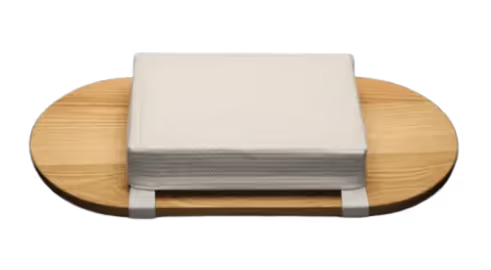
The Neck Pain & Sleep Reset Kit™ by Unusually Usual is a corrective alignment tool: a hand-finished Lithuanian ash sleep support with an adjustable-height insert, designed by Ilona Navickienė for back and side sleeping. Because it doesn't compress, the height you set is the height you sleep at, whichever of the two positions you turn to. It has not been tested in its own clinical trial, and we claim no CE mark or medical-device approval. The evidence, and its limits, are on our clinical claims page.
If you mostly sleep on your stomach, the adaptation takes longer. Ask us before you buy.
What consistent Kit™ users report
89%Significantly less morning neck stiffness
68%Fewer morning headaches
79%Improved overall wellness
Self-reported by consistent Kit™ users, beginning at the four-week adaptation period. Not a clinical trial. Details on our clinical claims page.
“I slept comfortably. I didn't toss and turn like I normally do.”
90 Nights, because that is when the research reads its outcome. The largest sleep-surface trials take their measurements at three months, so we give you the whole window, not a shorter one that would close before the reading is taken. [9]
The adaptation guarantee
90 Nights. Thirty of them on it. Return shipping covered.
This is not a satisfaction guarantee. It is an adaptation guarantee.
Read the full guarantee“We don't force sleep. We remove what blocks it.”
For the bigger picture, our article What Is Phone Neck Syndrome? explains how daytime screen posture loads the neck, and the Journal also covers the first ninety nights and how to choose a sleep tool.
Key facts
EU-protected original · Registered design No. 009206642-0001
A corrective alignment tool for back and side sleeping — try it for 90 nights. All we ask is thirty of them.
Research-based design. Lifetime warranty. Natural Lithuanian ash, hand-finished in Lithuania. The evidence — and what it doesn't show — is there for you before you decide.
Explore the Kit™View clinical evidenceNot a satisfaction guarantee — an adaptation guarantee. 90 Nights. Thirty of them on it. Return shipping covered.
People also ask
Common questions about sleep position and the neck
Short answers to the questions people ask most about how they sleep.
Can you train yourself to sleep in a different position?
Often, yes, with patience over a few weeks. Most position changes happen in lighter sleep, without your noticing, so props help more than willpower: a body pillow behind your back or against your front stops you rolling, and a firm pillow beside you makes it harder to turn onto your stomach. Expect to drift back now and then — that's normal.
→ Full answer: Practical steps for each position
Why does my neck hurt on the side I sleep on?
Often because the support height doesn't suit your side position. If it's too low, the neck bends down toward the mattress for hours; if it's too high, it bends up. Check whether your head sits level with your spine when you lie on your side. If the pain persists, or comes with numbness, tingling or weakness in the arm, see a doctor or physiotherapist.
→ Full answer: The three positions: what we know
Can changing sleep position help with headaches?
Some headaches start in tight muscles at the top of the neck, and a position that keeps the neck in line through the night may help those for some people. The evidence is limited, so treat it as worth trying rather than a fix. See a doctor for any new, severe or sudden headache, one that differs from your usual pattern, or one that comes with fever, weakness, confusion or changes in vision.
→ Read more: Headaches and phone neck
Do my spinal discs recover overnight?
Discs have very little blood supply of their own; they take in fluid and nutrients by diffusion, which is helped by lying down after a day upright. [1] That's part of why you're slightly taller in the morning. There's no reliable figure for how many hours that takes, and we don't claim that any sleep position or product changes disc health.
→ Full answer: Why the night matters to your neck
Is stomach sleeping ever acceptable if I have neck problems?
It's the most demanding position for the neck, but some people find it the only one they can sleep in. If that's you, a very thin support — or a small one under the forehead, so the face doesn't turn as far — reduces how much the neck has to rotate. If you have a diagnosed neck condition or symptoms in the arm, talk to a doctor or physiotherapist about your sleep position.
→ Full answer: Practical steps for each position
Does mattress firmness affect neck alignment?
Yes, indirectly. A very soft mattress lets the shoulders and hips sink, which changes the height your neck needs, especially on your side. A review of controlled mattress trials found medium-firm mattresses did best for comfort, sleep quality and spinal alignment. [8] If you change your mattress, check your support height again.
→ Full answer: What the evidence does — and doesn't — show
Medical disclaimer: This article is for informational and educational purposes only and does not constitute medical advice. Mind Your Sleep by Unusually Usual does not diagnose, treat or cure any medical condition. Always consult your qualified healthcare provider before making changes to your health management or sleep routines. Research is cited with its limits; individual experiences vary.
References
- Urban JP, Roberts S. Degeneration of the intervertebral disc. Arthritis Research & Therapy. 2003;5(3):120–130. doi:10.1186/ar629
- Skarpsno ES, Mork PJ, Nilsen TIL, Holtermann A. Sleep positions and nocturnal body movements based on free-living accelerometer recordings: association with demographics, lifestyle, and insomnia symptoms. Nature and Science of Sleep. 2017;9:267–275. https://pubmed.ncbi.nlm.nih.gov/29138608/
- Lei JX, Yang PF, Yang AL, Gong YF, Shang P, Yuan XC. Ergonomic considerations in pillow height determinants and evaluation. Healthcare (Basel). 2021;9(10):1333. https://pmc.ncbi.nlm.nih.gov/articles/PMC8544534/
- Pang JCY, Tsang SMH, Fu ACL. The effects of pillow designs on neck pain, waking symptoms, neck disability, sleep quality and spinal alignment in adults: a systematic review and meta-analysis. Clinical Biomechanics. 2021;85:105353. https://pubmed.ncbi.nlm.nih.gov/33895703/ — The review found no effect on subjective sleep quality.
- Jiao R, et al. The impact of pillow height on neck muscle activity: a pilot study. Sleep and Breathing. 2024. https://pubmed.ncbi.nlm.nih.gov/39625641/
- Cary D, Briffa K, McKenna L. Identifying relationships between sleep posture and non-specific spinal symptoms in adults: a scoping review. BMJ Open. 2019;9(6):e027633. https://pmc.ncbi.nlm.nih.gov/articles/PMC6609073/
- Cary D, Jacques A, Briffa K. Examining relationships between sleep posture, waking spinal symptoms and quality of sleep: a cross sectional study. PLoS ONE. 2021;16(11):e0260582; correction 2024;19(7):e0306662. https://pmc.ncbi.nlm.nih.gov/articles/PMC8631621/
- Radwan A, et al. Effect of different mattress designs on promoting sleep quality, pain reduction, and spinal alignment in adults with or without back pain; systematic review of controlled trials. Sleep Health. 2015;1(4):257–267. doi:10.1016/j.sleh.2015.08.001
- Kovacs FM, Abraira V, Peña A, et al. Effect of firmness of mattress on chronic non-specific low-back pain: randomised, double-blind, controlled, multicentre trial. The Lancet. 2003;362(9396):1599–1604. https://pubmed.ncbi.nlm.nih.gov/14630439/ — Cited for its ninety-day measurement point only.
Our approach
Neck Pain & Sleep Reset Kit™
Physiotherapist-designed · EU-protected original · 90-Night Adaptation Guarantee · Lifetime Warranty



Investment in your wellness
Your body has been waiting long enough.
The Neck Pain & Sleep Reset Kit™ by Unusually Usual® -
a registered Community design, made for a range of body types and sleep positions.
begin my recovery
90-Night Guarantee · Lifetime Warranty · Ships Worldwide · EU-Registered
Mind Your Sleep
Get Unusually Usual now
mind your Sleep
get UNUSUALLY USUAL now
Want to see howwe help people?
we help
people?
Free resources, from the heart

Workshops
Body Mindfulness Videos
PDFs
Join Unusually Usual ® Followers
& get a free webinar now!
& get a free webinar now!
Thank you! Your submission has been received!
Oops! Something went wrong while submitting the form.