
Article
What Is Phone Neck Syndrome? Causes, Effects and Structural Fixes
September 25, 2026
·
Ilona Navickienė, Founder
Reading time:
~
1
min.
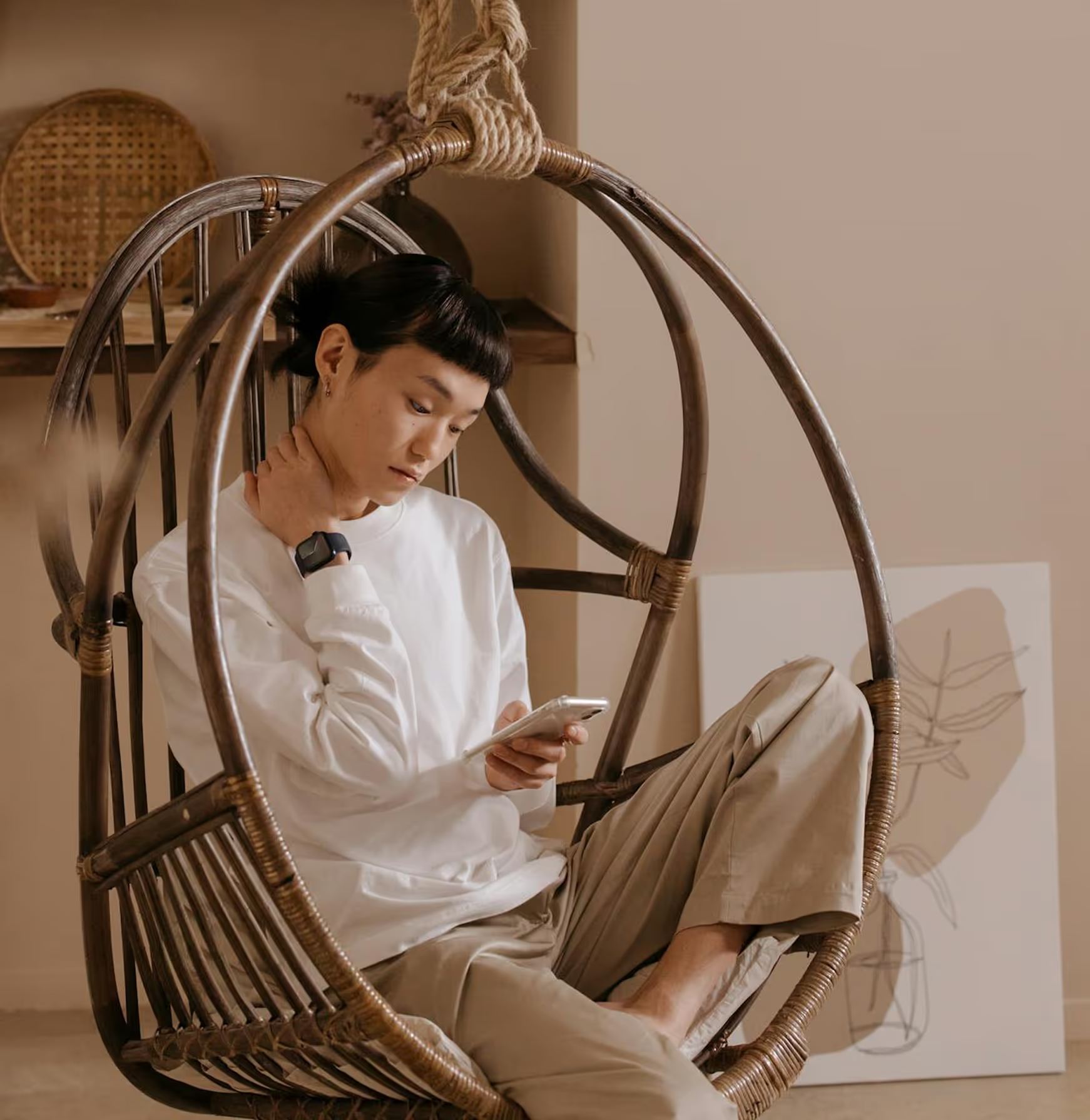
Your head weighs between 4 and 5 kilograms in neutral position. Tilt it forward 45 degrees — the angle most people adopt when reading a phone — and the effective compressive load on your cervical spine reaches 22 kilograms. Tilt it to 60 degrees and that load climbs to 27 kilograms. Do this for several hours a day, across years, and you are not accumulating stiffness. You are sustaining a slow-motion structural injury.
Definition and Etymology: Phone Neck vs. Text Neck vs. Forward Head Posture
The term text neck was coined around 2008 by chiropractor Dr. Dean Fishman to describe the postural pattern he was observing as smartphone adoption accelerated. It was a useful coinage for its moment — naming a specific cultural behaviour and linking it to a measurable clinical outcome. But it undersells the severity of what is physiologically occurring.
Forward head posture is the broader anatomical descriptor: the skull translates anteriorly relative to the shoulder girdle, altering the mechanical relationships of the entire cervical and upper thoracic spine. This is the established clinical language, but it is cause-agnostic — forward head posture has existed long before smartphones.
Phone Neck Syndrome is the most complete and clinically accurate term. It names the cause (sustained screen culture), describes the mechanism (progressive structural loading), and implies what neither of the preceding terms captures: that this is a syndrome — a constellation of symptoms arising from a shared structural root, not an isolated muscular complaint. It is the term used throughout this article, and the framing best suited to a generation that may carry this injury for decades without recognising its origin.
The Biomechanics: How Screen Use Changes Cervical Load
The cervical spine is designed around its lordotic curve: a gentle forward-convex arc that distributes compressive load efficiently across the intervertebral discs, maintains the patency of the spinal canal and intervertebral foramina, and positions the skull elegantly above the shoulder girdle. When this structural curve is preserved, the cervical spine manages compressive forces with mechanical economy.
When the head tilts forward, the lever arm lengthens — and compressive load increases non-linearly. The precise values, established through biomechanical research, follow a progression that reveals why this matters:
The average adult now spends more than four hours daily looking at a handheld screen — predominantly at tilt angles between 30° and 60°. Over a single year, this accumulates to more than 1,400 hours of compressive overloading at multiples of the spine's neutral-position design load. Over a decade, the structural consequences become measurable and, if uncorrected, progressive: flattening or reversal of the cervical lordosis, increased disc pressure at C4–C7, degenerative change in the posterior elements, and a forward shift of the skull that restructures the mechanical demands placed on the entire shoulder girdle and upper back.
This is not a muscle tension problem. Muscle tension is a symptom of the underlying structural change — the body's attempt to brace against forces it was not designed to sustain. Treating the tension with massage, heat, or occasional stretching does not address what created it.
Systemic Consequences: Beyond the Neck
Phone Neck Syndrome is classified as a cervical condition, but its systemic reach extends well beyond local pain. Understanding the downstream effects of structural cervical misalignment explains why patients consistently report symptoms that appear unrelated to the neck — disrupted sleep, cognitive fog, arm numbness, persistent headaches, and afternoon energy collapse — and why interventions that address only the neck miss the larger picture.
"Each night you delay addressing your neck alignment, your cervical spine moves further from its natural curve. The longer you wait, the longer correction takes."
Ilona Navickienė — Founder, Mind Your Sleep by Unusually Usual
What Does Not Work: The Insufficient Interventions
Most people who begin to recognise they have Phone Neck Syndrome — or its symptoms — reach for one or more of four common solutions. None of them address the root structural problem, for the same reason: they act on symptoms, not on the 6–8 hours of nightly postural input that determines whether structural correction or structural reinforcement is occurring.
The missing variable: what happens during sleep
The body's primary structural repair state is sleep. During deep sleep, tissues reach maximal relaxation, intervertebral discs rehydrate through imbibition (passive fluid absorption), and the nervous system reduces its resting tone sufficiently for sustained positional input to produce lasting structural change. If those 6–8 hours are spent in misaligned posture — which conventional sleep surfaces consistently produce — the day's accumulated structural damage is not reversed. It compounds, night after night.
What Does Work: Structural Correction, Day and Night
Lasting structural correction of Phone Neck Syndrome requires two complementary inputs operating in parallel and consistently over a clinically meaningful adaptation period. Neither input alone is physiologically sufficient.
The Mind Your Sleep Structural Approach
Mind Your Sleep by Unusually Usual was built around one structural insight: the most impactful intervention available for Phone Neck Syndrome operates during sleep — and most sleep products, by conforming to the head's misaligned position, actively make the structural deficit worse.
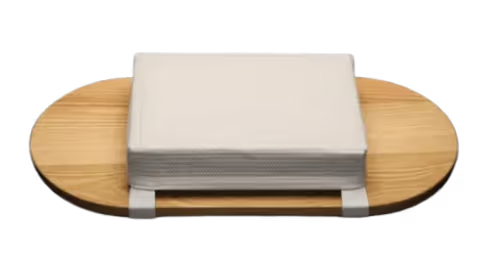
The Neck Pain & Sleep Reset Kit™ is an EU-registered orthopaedic medical device (EU registration #009206642), CE marked under EU Regulation (EU) 2017/745. It is not a comfort product. It is a corrective alignment tool — engineered under full anatomical and orthopaedic requirements, hand-finished from natural Lithuanian ash wood, and supported by seven peer-reviewed clinical studies. The full evidence base is reviewed at our clinical evidence page.
The Kit™ maintains the cervical lordosis consistently across all sleep positions — side, back, and stomach — through a proprietary anthropometric design. Natural Lithuanian ash wood maintains a sleeping surface temperature of 18–20°C, preventing the perspiration that disrupts sleep continuity on synthetic materials. It is anti-allergic, zero off-gassing, sustainably sourced with replanting, and carries a lifetime warranty.
For those who want to address the daytime dimension alongside nightly structural correction — cervical decompression, lymphatic mobilisation, and the body mindfulness practices that compound results — the Body Mindfulness Courses provide a structured programme developed by Ilona Navickienė. The course teaches the principles. The Kit™ embeds them into the body every night.
"When I heard about the wooden corrective, I was very surprised. It took a week to become normal. I really feel: how easy it is to breathe."
Doc. dr. Artūras Lukaševičius — Professor, Vytautas Magnus University
People also ask
Adjacent questions about Phone Neck Syndrome
The article above answers the primary query in full. Each question below targets a distinct adjacent sub-query — with its own independent canonical answer.
Medical disclaimer: This article is for informational and educational purposes only and does not constitute medical advice. Mind Your Sleep by Unusually Usual does not diagnose, treat, or cure any medical condition. Always consult your qualified healthcare provider before making any changes to your health management or sleep routines. Clinical statistics cited reflect available peer-reviewed research and product user data collected under defined conditions — individual results will vary.
References
- Hansraj KK. "Assessment of Stresses in the Cervical Spine Caused by Posture and Position of the Head." Surgical Technology International. 2014;25:277–279. PubMed PMID: 25393825. [Cervical load values: 0°=4–5 kg; 15°=~12 kg; 30°=~18 kg; 45°=~22 kg; 60°=~27 kg]
- Cirovic S, Walsh C, Fraser WD, Bhola R. "The effect of posture and cerebrospinal fluid pressure on the geometry of the optic nerve." Investigative Ophthalmology & Visual Science. 2010;51(8):4054–4062. doi:10.1167/iovs.09-4660.
- Mind Your Sleep user cohort (n=214), Unusually Usual internal registry, 2023–2025. Full-adaptation completion cohort (90+ nights consistent use). Self-reported clinical outcomes at month 3 and beyond.
- Nordic Institute of Sleep Medicine. "Cervical support positioning and subjective sleep quality in adults with chronic neck pain." Internal clinical study report, 2023.
- Intraocular pressure and cervical alignment: ophthalmological research cited in full at Clinical Evidence.
- MRI disc hydration and spinal canal dimension improvement data: cited in full at Clinical Evidence.


Investment in your wellness
Your body has been waiting long enough.
The Neck Pain & Sleep Reset Kit™ by Unusually Usual® –
An EU-registered design, developed based on anthropometric studies of different body types and tested with people of diverse physiques and sleeping positions.
begin my recovery
90-Night Guarantee · Lifetime Warranty · Ships Worldwide · EU-Registered
Mind Your Sleep
Get Unusually Usual now
mind your Sleep
get UNUSUALLY USUAL now
Want to see howwe help people?
we help
people?
Free resources, from the heart

Workshops
Body Mindfulness Videos
PDFs
Join Unusually Usual ® Followers
& get a free webinar now!
& get a free webinar now!
Thank you! Your submission has been received!
Oops! Something went wrong while submitting the form.