
Why Your Pillow May Be Making Your Neck Pain Worse — and What Helps
A pillow designed to feel soft can leave your neck at the wrong height for hours. Here is how to tell whether yours is part of the problem, what the research says about height and firmness, and what to look for instead.
October 16, 2026
·
Ilona Navickienė, Founder
·
Reading time:
~
1
min.

Most people with recurring neck pain have tried more than one pillow. Each new one feels good in the shop and promising on the first night — and a few weeks later, the mornings are the same. That pattern isn't bad luck, and it usually isn't about the brand or the price. More often, it's about the height your neck actually sleeps at, and what happens to that height once your head is on the pillow.
This article explains how a pillow can work against your neck, the signs that yours might be part of the problem, and what to look for instead. It also explains where our Neck Pain & Sleep Reset Kit™ fits — and where it doesn't.
Comfort and Support Pull in Different Directions
A soft pillow does one thing when your head lands on it: it yields. It spreads the weight of your head over a larger area, which is exactly why it feels comfortable. But it also means the height under your head is whatever is left once the filling has compressed — and that is rarely the height your neck needs.
On your side, a pillow that sinks too far lets the neck bend down toward the mattress. On your back, a pillow that's too thick pushes the chin toward the chest, and one that's too flat lets the head tip back. Support height changes how hard the neck muscles work during sleep [1] and how the cervical spine is aligned — especially on your side. [2][3]
A soft pillow supports your head in whatever position it sinks to. A firm support holds a height you've chosen. That's the whole difference, and it's easy to miss in a shop.
None of this means a soft pillow is harmful, or that it causes neck pain on its own. It means that if you already wake stiff, the height your pillow gives you is one of the first things worth checking.
Five Ways a Pillow Can Work Against Your Neck
These apply in different degrees to different materials. You may recognise one, or several.
It loses height under your head
Soft fillings compress under the weight of your head, so the height you sleep at is lower than the height you see when the pillow is empty. On your side, that lost height lets the neck bend down toward the mattress.
It's the wrong height for how you sleep
Side sleeping usually needs more height than back sleeping, and most people change position about 1.6 times an hour. [4] A pillow that suits one position can be wrong for the other.
It has flattened with age
Foam softens and loose fillings clump and shift with use. A pillow that suited you two years ago may be giving you a different height today, without any obvious sign.
It runs warm
Some foams hold heat. If you sleep hot, it's worth noticing: being too warm in bed is linked with more waking during the night. [5]
It lets you sleep twisted
A pillow that's too soft or too thick can push you toward half-stomach, twisted postures. People who wake with neck symptoms spend more time in twisted or extended postures — a link, not proof of cause. [6]
Signs Your Pillow May Be Part of the Problem
None of these is a diagnosis. Together, they're a good reason to look at your pillow before anything else.
Worth checking if…
- Your neck is stiffest when you wake, and eases as the day goes on.
- The stiffness is on the side you usually sleep on.
- You wake up folding the pillow, punching it into shape, or sleeping with an arm under it.
- The pillow is visibly flatter than it was, or no longer springs back.
- You often wake up hot.
A quick check: lie on your side and ask someone to look, or use a mirror. Your head should sit level with your spine, with your nose roughly in line with your breastbone. On your back, your chin should be neither tipped back nor pushed down toward your chest.
Pain that persists, or comes with numbness, tingling or weakness in the arm, needs a doctor or physiotherapist — not a new pillow.
How the Materials Compare
Every material has real strengths. The table compares general material properties against what your neck needs at night. These are not tests of particular products, and individual products vary.
How the main materials compare
General properties, not product test results
| Material | Holds height overnight | Adjustable height | Keeps shape over years | Feel |
|---|---|---|---|---|
| Standard foam | Compresses under the head | Usually not | Softens with use | Soft; can feel warm |
| Memory foam | Moulds to your current position | Some models, with inserts | Softens with use | Soft and slow to respond; can feel warm |
| Latex | Springier than foam, still yields | Some models | Lasts longer than foam | Resilient and breathable |
| Buckwheat | Holds better, but the hulls shift | Yes, by adding or removing hulls | Hulls break down over time | Firm and breathable; can rustle |
| Feather and down | Compresses easily; needs plumping | Some, by adding or removing fill | Clumps and flattens over time | Very soft and breathable |
| Water-filled | Yields to the head | Yes, by fill level | Depends on construction | Soft; can move under you |
| Solid wood (the Kit™) | Does not compress | Yes, with a height insert | Does not soften; lifetime warranty | Firm; needs an adaptation period |
No material in this table, wood included, has been shown in its own trial to reduce neck pain.
What to Look For Instead
If the problem is height that doesn't hold, the answer is a support built around four needs.
-
Need 1
A height that stays the same through the night
The height your neck has at 3 a.m. should be the height you chose when you lay down. That needs a support that doesn't compress, shift or flatten under the weight of your head.
-
Need 2
A height set to your body and position
Shoulder width, mattress firmness and whether you sleep on your back or side all change the height you need. [2] Look for a support you can adjust, rather than one fixed height for everyone.
-
Need 3
A shape that lasts
If the material softens, the height changes with it. Ask how long the product is expected to keep its shape — and whether the warranty backs that up.
-
Need 4
Honesty about evidence — and about comfort
Research supports the principle that height and shape matter. It hasn't shown that any pillow reduces chronic neck pain, and one review found no effect on sleep quality. [3] A firm support also feels strange at first. A seller who tells you both is one worth listening to.
The question to ask any pillow: what height does my neck actually sleep at — and is it the same at 3 a.m. as when I lay down?
Where the Kit™ Fits
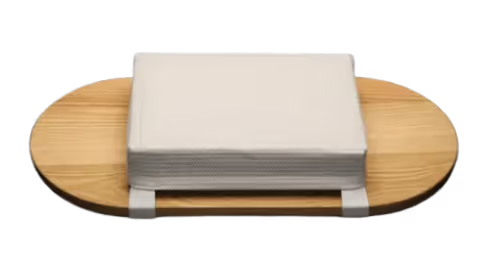
The Neck Pain & Sleep Reset Kit™ by Unusually Usual is a corrective alignment tool: a hand-finished Lithuanian ash sleep support with an adjustable-height insert, designed by Ilona Navickienė for back and side sleeping. It has no synthetic foam, it doesn't compress, and the sleep tool carries a lifetime warranty — so the height you set is the height you sleep at, tonight and in ten years. It has not been tested in its own clinical trial, and we claim no CE mark or medical-device approval. The evidence, and its limits, are on our clinical claims page.
Because it's firm, it feels different at first. The first nights are not the test: the first four weeks are an adaptation period, and the next four a consolidation period.
What consistent Kit™ users report
89%Significantly less morning neck stiffness
68%Fewer morning headaches
79%Improved overall wellness
Self-reported by consistent Kit™ users, beginning at the four-week adaptation period. Not a clinical trial. Details on our clinical claims page.
“I'm not going back to that normal, regular soft pillow anymore.”
90 Nights, because that is when the research reads its outcome. The largest sleep-surface trials take their measurements at three months, so we give you the whole window, not a shorter one that would close before the reading is taken. [7]
The adaptation guarantee
90 Nights. Thirty of them on it. Return shipping covered.
This is not a satisfaction guarantee. It is an adaptation guarantee.
Read the full guaranteeFor more, our article What Is Phone Neck Syndrome? explains how screen posture loads the neck by day, and the Journal also covers sleep position, the first ninety nights and how to choose a sleep tool.
Key facts
EU-protected original · Registered design No. 009206642-0001
Not a softer pillow. A height that stays where you set it — try it for 90 nights. All we ask is thirty of them.
Research-based design. Lifetime warranty. Natural Lithuanian ash, hand-finished in Lithuania. The evidence — and what it doesn't show — is there for you before you decide.
Explore the Kit™View clinical evidenceNot a satisfaction guarantee — an adaptation guarantee. 90 Nights. Thirty of them on it. Return shipping covered.
People also ask
Common questions about pillows and neck pain
Short answers to the questions people ask most about their pillow.
How do I know if my pillow is causing my neck pain?
You can't know for certain, but some signs make it worth checking: stiffness that's worst on waking and eases through the day, stiffness on the side you sleep on, waking up reshaping the pillow, or a pillow that has visibly flattened. Check whether your head sits level with your spine on your side, and whether your chin is neither tipped back nor pushed down on your back. If the pain persists, or comes with numbness, tingling or weakness in the arm, see a doctor or physiotherapist.
→ Full answer: Signs your pillow may be part of the problem
Is a high or low pillow better for neck pain?
Neither, in general. Side sleeping usually needs more height to fill the gap between ear and shoulder; back sleeping usually needs less, so the head isn't pushed forward. Too low, and the neck bends down or the head tips back; too high, and it bends the other way. Firmness decides whether the height you choose is the height you actually sleep at.
→ Full answer: Comfort and support pull in different directions
Can a contoured foam pillow help?
It can suit some people. A contour acknowledges the curve of the neck, which is a good starting point. But foam still compresses under the head and softens with age, so check that the height suits your position and keep an eye on it over time. No pillow design has been shown to reduce chronic neck pain. [3]
→ Full answer: How the materials compare
Is sleeping without a pillow better than sleeping on a soft one?
For some back sleepers on a firm mattress, no pillow feels fine. For side sleepers it usually isn't: without support, the neck bends down toward the mattress for hours. Going without isn't a cure either way — what matters is the position your neck ends up in.
→ Read more: The three sleep positions
Why does my neck hurt more after buying an expensive new pillow?
Price doesn't predict fit. If the new pillow is the wrong height for your position, a better-made one simply holds the wrong height more consistently. If it's firmer than your old one, some stiffness in the first weeks can be part of adapting. Sharp pain, numbness or tingling is not — stop, and see a doctor or physiotherapist.
→ Full answer: What to look for instead
How long should I try a new pillow before deciding?
For a comfort pillow, a couple of weeks tells you most of what you need to know. A firm support is different: the first four weeks are adaptation, and the largest sleep-surface trials read their outcomes at around three months. [7] That's why our guarantee asks for thirty nights first, within a ninety-night window.
→ Read more: What to expect, stage by stage
Medical disclaimer: This article is for informational and educational purposes only and does not constitute medical advice. Mind Your Sleep by Unusually Usual does not diagnose, treat or cure any medical condition. Always consult your qualified healthcare provider before making changes to your health management or sleep routines. Research is cited with its limits; individual experiences vary.
References
- Jiao R, et al. The impact of pillow height on neck muscle activity: a pilot study. Sleep and Breathing. 2024. https://pubmed.ncbi.nlm.nih.gov/39625641/
- Lei JX, Yang PF, Yang AL, Gong YF, Shang P, Yuan XC. Ergonomic considerations in pillow height determinants and evaluation. Healthcare (Basel). 2021;9(10):1333. https://pmc.ncbi.nlm.nih.gov/articles/PMC8544534/
- Pang JCY, Tsang SMH, Fu ACL. The effects of pillow designs on neck pain, waking symptoms, neck disability, sleep quality and spinal alignment in adults: a systematic review and meta-analysis. Clinical Biomechanics. 2021;85:105353. https://pubmed.ncbi.nlm.nih.gov/33895703/ — The review found no effect on subjective sleep quality.
- Skarpsno ES, Mork PJ, Nilsen TIL, Holtermann A. Sleep positions and nocturnal body movements based on free-living accelerometer recordings: association with demographics, lifestyle, and insomnia symptoms. Nature and Science of Sleep. 2017;9:267–275. https://pubmed.ncbi.nlm.nih.gov/29138608/
- Okamoto-Mizuno K, Mizuno K. Effects of thermal environment on sleep and circadian rhythm. Journal of Physiological Anthropology. 2012;31:14. doi:10.1186/1880-6805-31-14
- Cary D, Jacques A, Briffa K. Examining relationships between sleep posture, waking spinal symptoms and quality of sleep: a cross sectional study. PLoS ONE. 2021;16(11):e0260582; correction 2024;19(7):e0306662. https://pmc.ncbi.nlm.nih.gov/articles/PMC8631621/
- Kovacs FM, Abraira V, Peña A, et al. Effect of firmness of mattress on chronic non-specific low-back pain: randomised, double-blind, controlled, multicentre trial. The Lancet. 2003;362(9396):1599–1604. https://pubmed.ncbi.nlm.nih.gov/14630439/ — Cited for its ninety-day measurement point only.
Our approach
Neck Pain & Sleep Reset Kit™
Physiotherapist-designed · EU-protected original · 90-Night Adaptation Guarantee · Lifetime Warranty




Investment in your wellness
Your body has been waiting long enough.
The Neck Pain & Sleep Reset Kit™ by Unusually Usual® -
a registered Community design, made for a range of body types and sleep positions.
begin my recovery
90-Night Guarantee · Lifetime Warranty · Ships Worldwide · EU-Registered
Mind Your Sleep
Get Unusually Usual now
mind your Sleep
get UNUSUALLY USUAL now
Want to see howwe help people?
we help
people?
Free resources, from the heart

Workshops
Body Mindfulness Videos
PDFs
Join Unusually Usual ® Followers
& get a free webinar now!
& get a free webinar now!
Thank you! Your submission has been received!
Oops! Something went wrong while submitting the form.